Table of Contents
Tulare County Courts, CA *

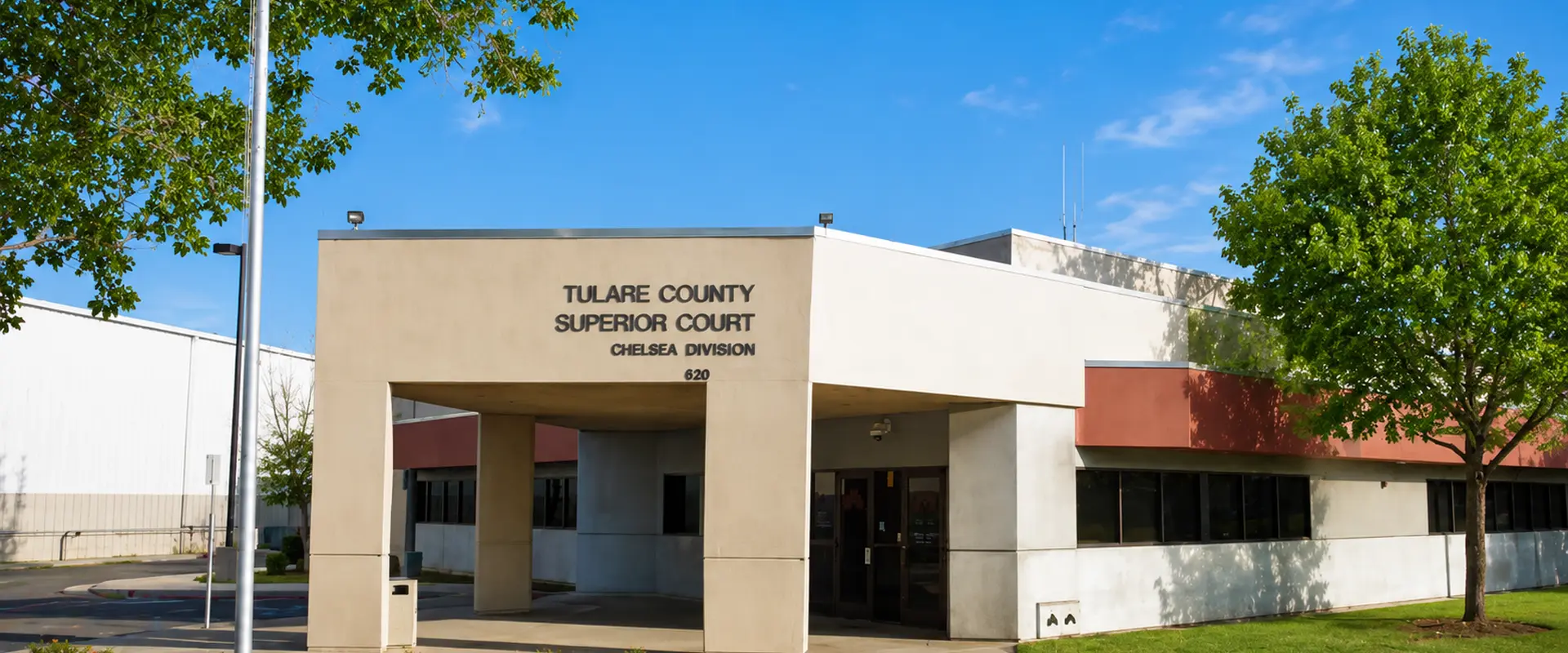
The Tulare County Superior Court is the main legal hub of Tulare County. Case types handled here are wide-ranging, including civil, criminal, probate, juvenile, and family. Because the local economy runs on agriculture, some of the major court cases revolve around land use disputes and water rights conflicts, contract litigation between growers and packers, and labor disputes.
The state of California has a unified superior court system where a single Superior Court handles all case types rather than separate courts at different levels. Tulare County, thus, has one Superior Court that hosts different divisions managing different case types. However, each of these divisions have their own rules and regulations to ensure the court serves the residents of Tulare efficiently.
Overview of the Tulare County Court System
California consolidated its municipal and superior courts through a statewide unification process in 1998, which means that cases in Tulare County are now managed under one unified Superior Court. The Superior Court handles all legal matters through multiple facilities located throughout the county and under the oversight of the California Judicial Council.
The Superior Court of California, County of Tulare, operates several courthouses: the main County Civic Center in Visalia, and additional facilities, including the Porterville courthouse in the South and Dinuba in the North.
California courts are public institutions, making most records filed with the court available to the public, apart from a few exceptions that include sealed cases, juvenile records, and certain sensitive family law matters. In recent years, the court has made remote record lookups easier than ever before. Since there are multiple divisions, make sure to confirm which one you need for your case before visiting.
Types of Courts in Tulare County, CA

Because of the unified Superior Court structure, Tulare County organizes its legal work into several divisions. Each division has specific responsibilities and handles different case types with its own procedures. Tulare County has made the courts accessible by dividing functionalities for different courthouses.
Primary Locations:
- Main Courthouse (located in Visalia): Handles criminal cases, civil lawsuits, and family law issues.
- Northern Courthouse (located at Dinuba): Serves the northern part of the county, mainly handling traffic cases, smaller criminal matters, and limited civil cases.
- Southern Courthouse (located at Porterville): Serves the southern part of the county and deals with criminal cases, traffic cases, and some civil matters.
 Criminal Division
The Tulare County Criminal Division handles every stage of felony and misdemeanor cases. Felonies are cases that have the potential of a state prison sentence, while misdemeanors typically result in county jail time, fines, or both.
The division manages all criminal case processes from arraignments and preliminary hearings to trials and sentencing. Because the stakes are high, the court strictly enforces court dates for criminal cases, and extensions are rarely granted.
When searching for criminal cases or requesting copies of criminal records, you will work with the Tulare County Criminal Division.
 Civil Division
The Civil Division handles disputes between private parties, including individuals, businesses, and organizations. The division splits civil cases into two categories, namely limited civil cases involving amounts under $25,000 and unlimited civil cases for claims exceeding $25,000.
The court hears:
- Breach of contract disputes
- Property damage claims
- Personal injury lawsuits
- Landlord-tenant issues
- Collection actions and adoption proceedings through the Foster Care department
Small claims cases also fall under the civil division's jurisdiction. These claims involve amounts up to $7,500, while businesses can claim up to $5,000. The small claims process is more accessible to people without formal legal training, which allows the court to manage high case volumes.
Additionally, the Civil Division handles protective order petitions, including
- Domestic Violence Restraining Orders (DVROs)
- Civil Harassment Restraining Orders, and
- Elder or Dependent Adult Abuse Restraining Orders
The Self-Help Center is a vital resource for litigants because it provides free assistance with these petitions. Finally, the Collections Department is responsible for enforcing court judgments and resolving debt collection issues.
 Family Law Court
The Tulare County Family Law Court handles legal matters involving marriage and family relationships. The court operates at the primary Tulare County Main Courthouse in Visalia.
Its jurisdiction includes:
- Divorce
- Legal separation and nullity
- Child custody and visitation
- Child support
- Parentage establishment
- Domestic partnerships
- Spousal support
- Property division
Tulare County Family Court also has a Family Law Facilitator's Office that helps residents complete paperwork, understand court procedures, and obtain referrals. The office also offers mediation services for custody, guardianship, and visitation disputes. A mediator helps both parties and any involved family members to reach a voluntary agreement.
 Juvenile Court
The Juvenile Court handles cases involving minors under age 18. These cases fall into two categories, namely:
- Delinquency Cases: They involve minors accused of crimes.
- Dependency Cases: They involve children who may have suffered abuse, neglect, or placement at risk.
Case proceedings in this division are not open to the general public, and the records remain confidential. The main goal in juvenile court is rehabilitation and family preservation rather than punishment. This philosophy shapes the hearing process and available outcomes.
Primary Location: Juvenile Justice Center
 Probate Court
The Probate Court handles:
- Estate matters when someone dies, including asset distribution and will validation.
- Matters involving living individuals can no longer make decisions for themselves, such as conservatorships and granting legal authority over an incapacitated adult.
- Issue involving minors' protection under guardianship arrangements.
Probate matters require careful accounting and court oversight of assets; thus, they typically move slowly.
 Traffic Court
The Traffic Division handles less severe traffic matters, including infractions and misdemeanor traffic violations.
Its jurisdiction covers:
- Speeding tickets
- Red light violations
- Driving without a license
More serious offenses, like criminal charges for DUI, move to the Criminal Division. In Tulare County, the traffic court has made it easier to process cases remotely. You can pay fines via the court's Virtual Public Counter page, which offers real-time, face-to-face assistance with court staff from your computer or mobile device. You can also contest a ticket or request a fine reduction through the MyCitations online tool. Finally, you can use the county's Online Services access page to handle traffic case notices and reserve a traffic court date without visiting the courthouse.
 CARE Act Court
California's CARE Act (Community Assistance, Recovery, and Empowerment) created a new legal pathway to help individuals with serious mental health conditions and substance use disorders receive court-ordered treatment and support. Tulare County courts participate in the CARE Court program, offering these services to residents. This path to justice could be highly beneficial, especially for repeat offenders with mental health issues.
 Appellate Court
If you want to appeal your conviction, the Appellate Division processes appeals from limited civil cases (amounts under $25,000) and misdemeanor convictions. You should, however, note that the division does not decide appeals itself. It prepares the record and sends it to the appropriate reviewing court. For felony convictions and unlimited civil cases (over $25,000), appeals go to the California Court of Appeals for the Fifth District in Fresno.
How to Access Tulare County Court Records

Most court records in California are public documents, meaning most people have the right to view and obtain copies. Confidential cases include juvenile matters and sealed cases. Here is how you access available court records online so you can save time and effort.
 Online Access
Tulare County residents can use the court's public portal to search criminal cases and civil filings information remotely. The portal requires creating a free account. You can then search using a case number or party name. For federal cases in federal district and bankruptcy courts, the PACER system (Public Access to Court Electronic Records) provides access.
 Alternative Online Options
Sometimes official state tools can prove to be overwhelming, so third-party tools such as CourtCaseFinder can conduct broader public record searches across multiple jurisdictions. However, it only serves as a good starting point if you are unsure which office keeps the records you require. You should verify the most current information with the official court sites.
 In-Person Requests
You can access court records by physically visiting the courthouse, and the clerk can help locate what you need. The main location is the County Civic Center at 221 S. Mooney Blvd., Visalia. Building hours are Monday through Friday from 8:00 a.m. to 4:00 p.m. You should call (559) 730-5000 to schedule an appointment with the clerk to avoid any inconveniences.
 Archived Records
California has a specific record retention schedule that allows some case types to be destroyed after a set number of years. You may not locate some older records for this reason. To access existing archived information, submit a request to the Clerk's Office using the record request form available on the Tulare County Superior Court website. For historical court records, the California State Archives might hold the files you need.
For Attorneys and Legal Professionals
Licensed attorneys and their staff can request elevated access to the Tulare County Court's public portal following the court rules. eFiling is available for many case types through approved Electronic Filing Service Providers (EFSPs). The court only accepts electronic filing through an approved EFSP.
The California Rules of Court and Tulare County's local rules together govern procedure. Local rules are published on the Tulare County court's website local rule page and provide clarity before filing anything, since Tulare has specific requirements not always obvious from the state rules alone. The clerk can provide some guidance in case you are stuck.
How to File a Case in Tulare County

Attention to detail is required when filing a case, which can feel stressful, especially for first-time filers. The process requires filling out forms, paying fees, tracking deadlines, and following many procedures. Below are general steps to help you navigate the filing process in Tulare County.
 Step 1: Choose the Correct Court
Getting the right division saves you time and reduces the hassle of filing rejection. Since Tulare County has only one Superior Court, you do not have to choose a courthouse to visit. But you still need to determine the division that is the right one for your matter.
 Step 2: Complete Required Forms
After you determine the court you should visit, you need to find the right standardized Judicial Council forms. These are available free of charge on the California Courts forms page and through the clerk's office. Check the local forms section on the Tulare County Superior Court official website to confirm if your case type requires Tulare-specific forms. Ensure you have all the necessary signatures and attachments to avoid rejections.
 Step 3: File Your Case
After completing your forms, submit them to the clerk's office during official filing hours. You can file in person at the courthouse or through an approved eFiling service provider. Make sure your case type permits electronic filing to avoid delays. The clerk will review your paperwork, assign a case number, and provide a file-stamped copy.
 Step 4: Pay Filing Fees
Filing fees are based on the case type. Fees range from under $100 for small claims to several hundred dollars for unlimited civil cases. If you cannot afford the fee, you may apply by filling out Form FW-001. You can pay fees by cash, check, or credit card at the clerk's window. Underpayment could cause delays in your case.
 Step 5: Serve the Other Party
After filing, you are required to notify the other party of the case. California law requires notifying the other person through a process called service of process. This process requires having a person who is not part of the case deliver the court documents to the other party in person. You can work with a professional process server or the county sheriff.
 Step 6: Monitor Your Case
The court assigns hearing dates for your case after you complete the filing process. Track your case developments, such as added or changed motions and hearing dates, through the court's public portal using your case number. Missing a hearing date can result in a default judgment entered against you.
Tulare County Courthouse Directory
Tulare County has a unified court system with different divisions. The main courthouse in Visalia has two others in Porterville and Dinuba.
Superior Court, Tulare County (Main Courthouse)
Visalia
221 S. Mooney Blvd, Visalia, CA 93291
Phone: (559) 730-5000
Porterville (South County Justice Center)
Porterville
300 E. Olive Avenue, Porterville, CA 93257
Phone: (559) 782-3700
Dinuba Courthouse
Dinuba
640 South Alta Avenue, Dinuba, CA 93618
Phone: (559) 595-6400
Juvenile Justice Facility (Juvenile cases only)
Visalia
11200 Avenue 368, Room 201, Visalia, CA 93291
Phone: (559) 738-2300
Family Court Services (Mediation and counseling services)
Visalia
3400 W Mineral King Ave, Suite C, Visalia, CA 93291
Phone: (559) 737-5500
Main court website: tulare.courts.ca.gov
Online services portal: online.tulare.courts.ca.gov
Legal Help and Self-Help Resources
Navigating the Tulare County Court system can be difficult, especially without an attorney. The court offers several resources to help.
 Free Legal Assistance
Low-income residents and other litigants in Tulare County can benefit from the services of California Rural Legal Assistance (CRLA), which provides free civil legal aid on issues like housing, immigration, employment, and public benefits.
The Tulare County Bar Association provides referrals and can help connect you with local attorneys. Through this service, you may find an attorney who offers free initial consultations, particularly for family law and personal injury matters.
For domestic violence situations, the California domestic violence resources page lists the mandatory forms you need to file and offers further guidance on filing restraining orders without an attorney.
 Local Legal Support
The Tulare Superior Court has a Self-Help Resource Center that provides free in-person assistance for self-represented individuals. The clerk can help you find the right forms, explain court procedures, and review documents for completeness. The center assists with family law, civil, probate, guardianship, small claims, name changes, restraining orders, evictions, and CARE Act proceedings.
The Family Law Facilitator's Office focuses on child support, custody, visitation, and related matters. California also operates a statewide Online Self-Help Center with guides that help navigate these matters, FAQs, and form instructions organized by topic.
FAQs
How do I look up a court case in Tulare County?
You can access records through the Tulare Superior Court public portal by registering for free and searching using your case number or party name. You can also conduct detailed research through third-party tools like CourtCaseFinder.
Is there a way to get help with court forms without hiring a lawyer?
Yes. The Tulare County courthouse has a Self-Help Resource Center that guides you through finding and filling the right forms. The court also has a Family Law Facilitator who focuses on family-related paperwork. The center offers workshops on divorce, paternity, child support, custody, guardianship, and stepparent adoption.
Does Tulare County Superior Court have a special process for agricultural water disputes?
Yes. Because this issue falls under special civil matters, Tulare County courts handle water rights conflicts under California's reasonable use doctrine. Farmers can file petitions for water use determinations. The court will then coordinate with the State Water Resources Control Board on groundwater adjudications.
Does the Tulare County Superior Court offer remote appearances for hearings?
Yes. Tulare County Superior Court permits remote appearances using Zoom or telephone for most types of cases, such as civil, family law, probate, and certain traffic hearings. If you wish to make a remote appearance, then you need to request it at least three court days prior to your hearing via the court online portal or by submitting the Request to Appear Remotely using Form RA-010.
What happens if I miss my court date in Tulare County?
It depends on the nature of your case. A default judgment can be rendered in your absence in a missing civil case hearing. As an example, the court may issue a warrant to arrest you and even suspend your driver's license.
Other Counties in California
- Alameda
- Alpine
- Amador
- Butte
- Calaveras
- Colusa
- Contra Costa
- Del Norte
- El Dorado
- Fresno
- Glenn
- Humboldt
- Imperial
- Inyo
- Kern
- Kings
- Lake
- Lassen
- Los Angeles
- Madera
- Marin
- Mariposa
- Mendocino
- Merced
- Modoc
- Mono
- Monterey
- Napa
- Nevada
- Orange
- Placer
- Plumas
- Riverside
- Sacramento
- San Benito
- San Bernardino
- San Diego
- San Francisco
- San Joaquin
- San Luis Obispo
- San Mateo
- Santa Barbara
- Santa Clara
- Santa Cruz
- Shasta
- Sierra
- Siskiyou
- Solano
- Sonoma
- Stanislaus
- Sutter
- Tehama
- Trinity
- Tuolumne
- Ventura
- Yolo
- Yuba
Table of Contents
